
Kailua Directory Runs and Repositories
Kailua does not have one neat shelf bearing only the town's name. Early entries sit within Hawaiian Kingdom, Hawaiian Islands, Honolulu, Oʻahu, territorial, and City and County directory families. The most local title is the Windward Register, while the longer chronology comes from Husted and Polk-Husted volumes. A search should therefore follow both the modern place name and the geographic label used when the book was printed.
| Collection | Years | Where held | Access |
|---|---|---|---|
| Kingdom directories and handbooks | 1880/81 through 1894/95 | State Archives and UH eVols | Selected free scans; hard copies |
| Husted directory family | 1896/97 through 1910 | State Archives and selected eVols | Digital scans and cataloged books |
| Polk-Husted / Polk Honolulu runs | 1911 through post-1947 years | State Archives and library holdings | Catalog request; verify each volume |
| Island directory microfiche | 1954 through 1987 | Hawaiʻi and Pacific collections | Microfiche, staff-assisted |
| Windward Register, Kailua | 1958 to date noted | Archives/library holding record | Annual volume availability must be checked |
| Thrum's Hawaiian Annual | 1875 through 1974 | Research libraries and archives | Biographical and subject indexes |
Coverage is not the same as a complete annual run. The bibliography notes specific families and years, but local holdings can have gaps. No official page itemized a separate Kailua reverse-directory series. Telephone books and school yearbooks were also not confirmed in inspected Kailua branch holdings. Ask for the exact title and year before relying on a catalog summary.
Kailua City Directories Through Time
The publisher changes form a useful timeline because the place labels and directory scope shift with Hawaiʻi's government and Oʻahu's growth. The dates below come from the UH Hawaiian and Pacific bibliography, not from assumptions about uninterrupted publication.
| 1880/81 | Hawaiian Kingdom Statistical and Commercial Directory and Tourist's Guide |
|---|---|
| 1884/85 to 1894/95 | McKenney and Hawaiian Directory/Handbook families cover Kingdom-era names and institutions |
| 1896/97 to 1910 | Husted titles cross the Kingdom-to-Territory transition |
| 1911 to 1940/41 | Polk-Husted expands through Honolulu, Territory, then City and County labels |
| 1941/42 and 1947/48 onward | Polk's Honolulu and City and County volumes continue the address trail |
| 1958 to date noted | The annual Windward Register centers Kailua with classified and street-guide material |
A City Clerk history adds another label shift: the County Clerk dates to 1905, while an appointed City Clerk appears in 1958. That change helps explain why older public references may use different office and jurisdiction names even when they concern the same side of Oʻahu.
Digitized Kailua Directory Sources
The Hawaiʻi State Archives city-directory page connects researchers to hard copies and selected UH eVols scans. Digitized handles were documented for 1880/81, 1884/85, 1888, 1889, 1890, 1892, 1894/95, 1896/97, 1898, 1902, 1903/04, 1904/05, 1905/06, 1910, 1913, and 1924. The 1880/81 item is titled The Hawaiian Kingdom Statistical and Commercial Directory and Tourist's Guide.
A scan is easier to reach than a book, but it may not have reliable full-text recognition. Search the table of contents, alphabetical runs, place headings, business classes, and advertisements by eye. Record the handle and image page, not just a downloaded filename. No exact personal entry was machine-readable during research, so no sample name, address, column order, or abbreviation should be invented.
The Hawaiʻi Archives digital search supplies a second online route. If the desired year is absent, use the Archives catalog for the physical title and ask staff about inspection or a copy quote. A catalog record proves that an item exists; it does not promise a free scan.
Library Access to Kailua Directories
Kailua Public Library at 239 Kuulei Street is the local starting point, and staff can check catalog holdings or point to databases. The phone is 808-266-9911. The Hawaiʻi State Library's Hawaiʻi and Pacific Section at 478 South King Street holds broader local-history material. Ask whether a volume is a book, microfiche, database, or staff-mediated item, and confirm hours before a visit.
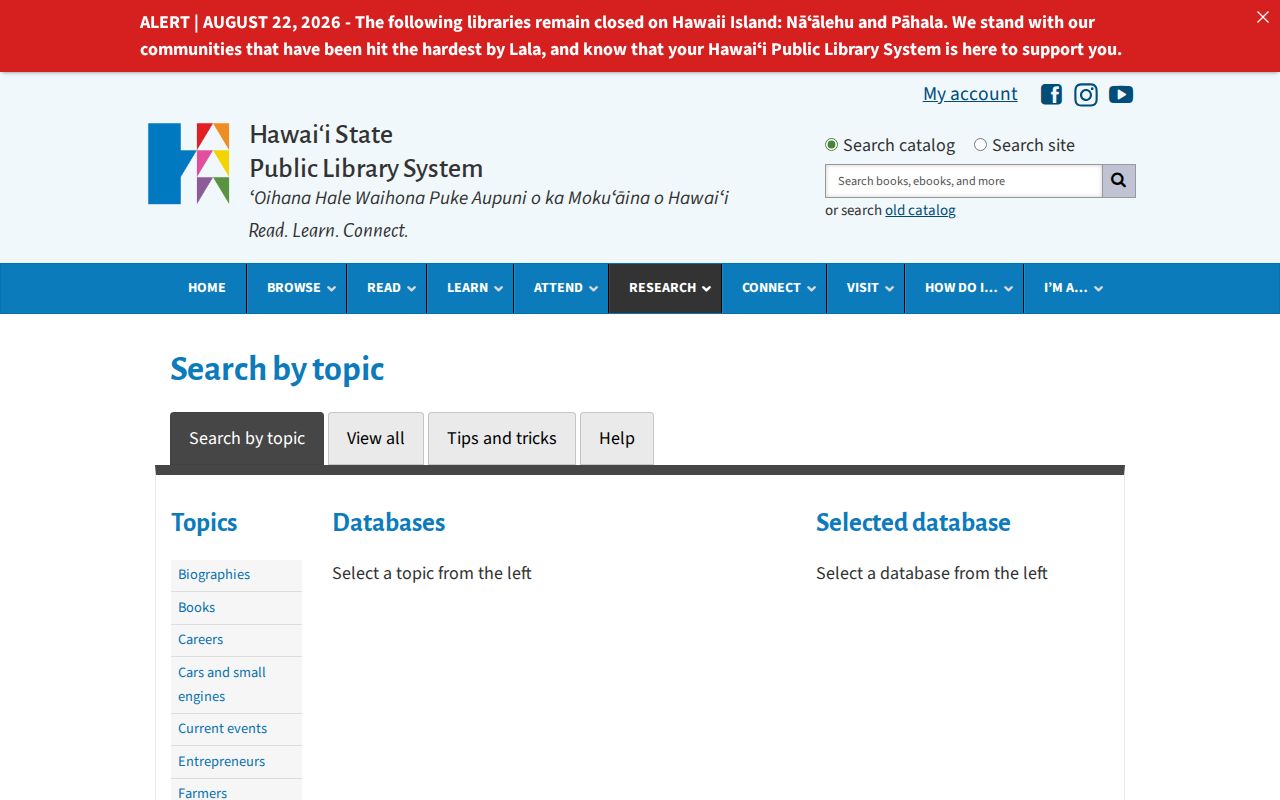
The HSPLS database landing groups genealogy, Hawaiʻi, and history resources. The captured page below is an entry point, not proof that every city directory is remotely searchable.
For a remote request, give the publication title, year, publisher, page or section if known, place label, and the name or street being checked. Ask about scan fees and copyright limits. Fragile originals may be inspection-only, and private donated collections may carry separate restrictions.
Read a Kailua City Directory Entry
A directory entry must be read within its own key. Capture the title page, year, publisher, page number, and alphabetical, street, or classified section before transcribing the entry. Note whether the text describes a person, household, firm, organization, public official, or advertisement. Historical books may omit Hawaiian diacritics or use initials, honorifics, shortened street types, and old district labels.
| Heading or name | Copy initials, honorifics, spelling, and cross-references as printed |
|---|---|
| Role or trade | May identify a business, profession, or civic role rather than residence |
| Street or place | Preserve the town, island, street number, and postal notation |
| Entry type | Distinguish household, organization, business, official, and advertisement |
| Page evidence | Save page number, image URL, access date, and legibility notes |
- Criss-cross directory
- A street-order section that moves from address to printed listing rather than name to address.
- Householder index
- A name list focused on the person under whom a household is filed; other members may not appear.
- Abbreviation key
- The volume's own list of short forms. Read it before expanding any mark or letter.
A dated listing may be a home, mailing point, firm, or club. It is not an official claim that every household member lived there for the whole year.
Kailua Research Beyond Directory Shelves
The Hawaiian Historical Society maintains noncirculating books, manuscripts, and newspapers. Its reading room operates by appointment on Thursday and Friday from 10 to 4 and Saturday from 10 to 2, with phone help at 808-537-6271 and email at hhsoffice@hawaiianhistory.org. Its online catalog should be checked before requesting a visit.
The Society's holdings page provides a useful second repository view.

Newspaper companions include marriage and birth notice indexes for 1850 through 1950, an obituary index for 1836 through 1950, Honolulu newspaper microfiche for 1929 through 1994, and the Hawaiʻi Newspaper Index from 1989. These tools can explain why a name appears, changes address, or vanishes, but many require staff help or manual review.
Kailua's Windward Register Story
The Windward Register is unusually specific to Kailua. The official holding describes an annual classified business and professional directory with a street-guide map, beginning in 1958 and noted as continuing to date. That makes it a better local lens than a broad Honolulu volume when the needed year survives.
Yet the holding summary does not list every annual volume or say which years contain a reverse section. Verify the exact year by catalog or librarian. Read the printed street guide together with the classified and alphabetical pages. A business ad may supply useful context, but label it as an advertisement. For current parcel facts, hand the address to the Kailua street directory workflow rather than stretching an old book beyond its date.
Place names also need care. A historical entry may use Kailua, Oʻahu, Honolulu, or Koʻolaupoko. Near Ulupō Heiau, older accounts organize place and people through an ahupuaʻa or chief-centered context rather than a modern ZIP or street. Preserve that old label beside a normalized modern search term.
Trace Kailua Families by Directory Year
A family-history search works best one year at a time. Start with a known name, address, street, or rough date. Choose the newest relevant Windward Register or Polk volume, then move backward. Compare both name and street sections when available, and keep a simple log of years searched, spellings tried, pages found, and gaps.
- Find the first sound listing and copy its citation, printed spelling, role, address, and entry type.
- Move one annual volume forward and backward. Note moves, changed initials, spouse or household headings, and missing years.
- Check the street section or guide. Record nearby listings only as directory evidence for that year.
- Pair directory years with census materials, including the historical Hawaiʻi name sets listed in the UH bibliography.
- Test the trail against newspapers, deeds, parcel history, court indexes, and eligible vital or cemetery records.
Disappearance has many causes. The person may have moved, died, changed a listed name, become unlisted, shifted under another householder, or fallen outside that edition's scope. A missing scan or absent Kailua section produces the same apparent silence. Record the negative search instead of turning it into a conclusion.
Several historical name sets can bridge years with no usable directory. The UH bibliography lists Hawaiʻi account and census books from 1840 through 1866, an 1890 census, and 1896 materials. It also identifies monarchy, circuit, and supreme court name indexes from roughly 1845 through 1893, plus First Circuit indexes extending from the mid-nineteenth century into the early twentieth. These are research leads, not modern resident rolls. Cite the exact index and date range, then request the underlying item before treating a same-name match as the same person.
Thrum's Hawaiian Annual offers a different view. Its biographical directory spans 1875 through 1974, with a name index for 1875 through 1932 and a subject index for 1875 through 1925. The Honolulu Blue Book of 1901 records names, addresses, reception days, clubs, and societies of leading residents. Neither work aimed to list a whole community. Use them for civic and social context, and state their selective scope whenever a Kailua family appears.
For a death trail, the State Archives' Oʻahu cemetery index, newspaper obituary index, and the holding cemetery or church are safer than guessing from a last directory appearance. No current Kailua municipal interment lookup was confirmed. A directory gap, obituary notice, and cemetery index may converge on one identity, but each source still needs its own citation and date.