
Kailua Address History by Era
A search for Kailua previous residents works best as a dated chain. Current parcel and permit systems establish the modern address and Tax Map Key, or TMK. The statewide land index then follows recorded interests back to its online cutoff. Printed directories and newspapers add people associated with the address, while archival maps and older government labels explain changes that a simple street search misses. Each source answers a different question, so an assessment owner should never be presented as an occupant without separate support.
| Record trail | Documented span | Access point | Useful evidence |
|---|---|---|---|
| RPAD and HoLIS | Current and historical fields | Honolulu property and parcel systems | Site address, TMK, sales, parcel shape, land and improvements |
| Bureau of Conveyances index | Online from 1976 | Statewide BOC portal; written or room research earlier | Recorded parties, dates, instruments, legal descriptions, related records |
| Windward Register | 1958 to date, with exact volumes to verify | Archives and library holdings | Kailua business, professional, classified, and street-guide clues |
| Husted and Polk families | 1880/81 through later City and County runs | State Archives, UH eVols, library collections | Names, addresses, work, firms, and household associations |
| Permits and address files | Varies by record series | DPP permit search, HNL Build, DAIB request | Building work, address changes, units, applicants, and dated plans |
Start with RPAD and HoLIS even when the goal is far in the past. Their common TMK helps connect a current street address to a legal description. For post-1976 transfers, move next to the Bureau of Conveyances online-services route. Earlier land work calls for a written search or reference-room visit. Identifying previous residents, rather than only past owners, requires annual directories, newspapers, and other household evidence.
Connect a Kailua Parcel
The City and County of Honolulu Real Property Assessment Division documents search by site address or a 12-digit Property ID. Its property record may show assessments, classifications, land and building details, sales history, and a fee-owner label. Copy the site address exactly, then copy the TMK without dropping leading zeroes. The mailing address is where notices go. It may be off-island or belong to an authorized representative, so it is not proof of any previous resident.
Open the official RPAD property-record entry point, then compare the parcel in HoLIS. Parcel geometry can expose a subdivision, consolidation, condominium property regime, or neighboring common area that changed the record path. DPP adds permit and address context. Its legacy Building Permit Search exposes address, TMK, application, permit, and date-range routes, while HNL Build supports current customer workflows. A full file may require a DAIB Request to View Records or a narrow UIPA request.
Trace Kailua Previous Owners
Kailua has no local county recorder. Hawaiʻi records conveyances statewide through the DLNR Bureau of Conveyances, which keeps both Regular System and Land Court material. Its current portal requires an account. Searching is free, but document images remain blurred and marked until purchased. The index covers documents recorded from 1976; older work shifts to a written request or research in the Public Research/Reference Room in Honolulu.
- Validate the present address with USPS and RPAD. Record the TMK, current legal description, and each dated sales-history field.
- Use the instrument number or TMK in BOC. Note the recording date, document type, system, grantor, grantee, and related document numbers.
- Search the earlier grantee later as a grantor. Repeat both name directions, alternate spellings, and the TMK rather than trusting one index hit.
- Split the chain when a subdivision, condominium regime, trust, estate, consolidation, or non-title instrument changes the path.
- At the 1976 online boundary, use the written search form or reference room. Mark the first unresolved link instead of filling it with a guess.
- Grantor and grantee
- The grantor gives an interest; the grantee receives it. Search both roles because the same party changes sides over time.
- Chain of title
- The dated sequence of recorded transfers and other title events tied to the same land.
- Legal description
- The land identifier written in the instrument. It can remain useful when a Kailua street name or house number changes.
- Regular and Land Court
- Regular System recording gives public notice, while Land Court certifies ownership. An index entry alone is not a title opinion.
Read Kailua Deed Results
The BOC search can use grantor or grantee names, TMK, Transfer Certificate of Title, document number, and recording date. Its official legacy field map also shows person or entity choices, exact and SoundEx name options, related-document searches, book and page, certificate number, document group, and a return-count control. Current controls may differ after login, so record what the live portal shows instead of promising an old form layout.
| Field to save | Reason it matters |
|---|---|
| Instrument and document type | Links RPAD sales history to the recorded item. |
| Regular or Land Court | Determines the recording system and related certificate trail. |
| Grantor, grantee, and date | Builds the backward sequence without assuming occupancy. |
| TMK and legal description | Keeps the land consistent across address changes. |
| Related lien or release | Prevents a release or lien code from being mistaken for a sale. |
BOC uses codes such as NL for liens and R for releases. Pair a release with the affected record. An easement, mortgage, or assignment can name people without conveying the home. This distinction keeps a Kailua previous residents timeline from turning every recorded party into a past household member.
The one successful image assigned to this page shows the official BOC account, fee, coverage, and image-access explanation.
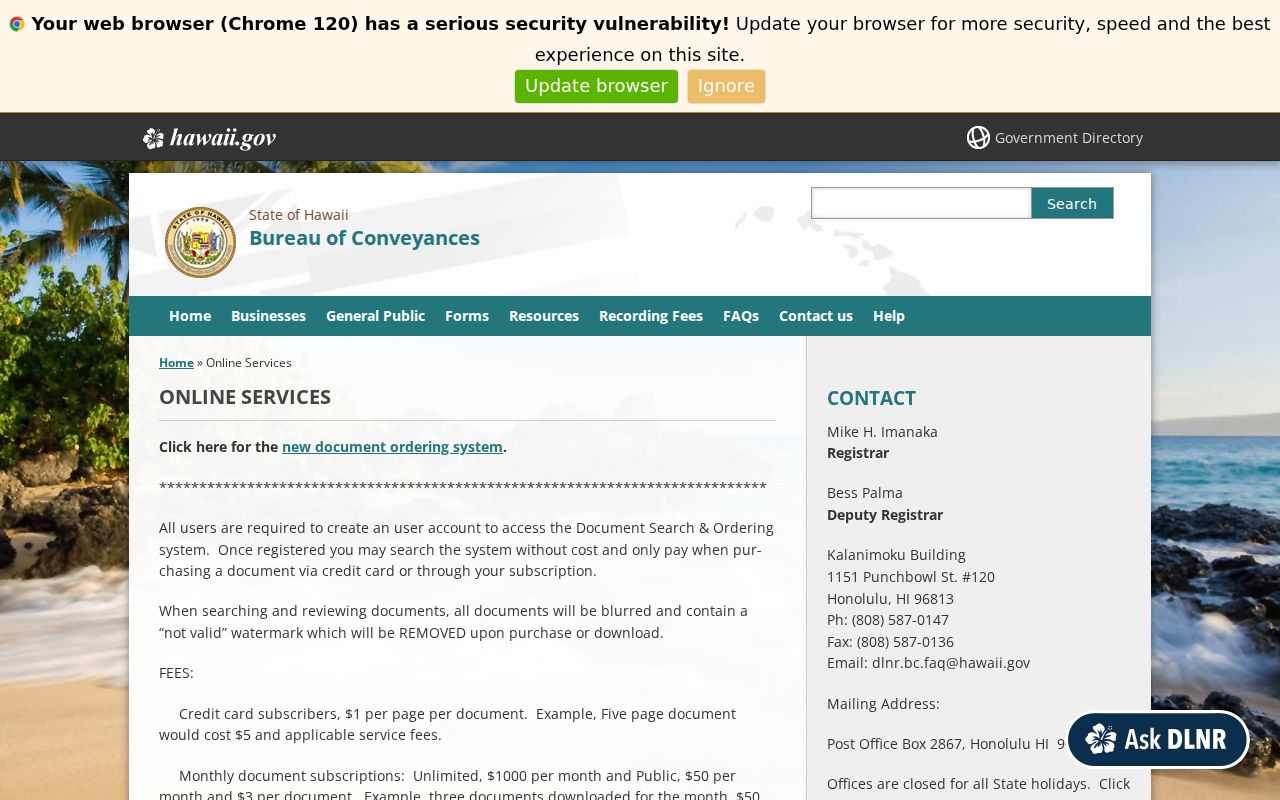
The screenshot helps set expectations before a search: the index route is statewide, online coverage begins in 1976, and clean document images use a paid account path.
Kailua Past Residents After 1958
The Windward Register is the most local printed clue found in the official holdings. The record describes a Kailua, Oʻahu annual run from 1958 to date and identifies classified business and professional content with a street-guide map. Exact volumes must be confirmed with a librarian. It helps place previous residents in a dated street context, but it is not a full roster of every household.
Search a volume close to a deed or permit date. Note the publication year, page, section, printed address, and whether the item is an entry or an advertisement. Then check the next available year. A name that vanishes may reflect a missing volume, a changed listing, or a move. It does not prove the date a person left. The broader Kailua city directory collections provide the shelf and publisher context without replacing this address-led timeline.
Older Kailua Place Names
Before the local annual run, search Husted, Polk-Husted, Polk, island directories, newspapers, and Archives holdings. Those sources may file the same place under Honolulu, Oʻahu, Hawaiian Islands, Windward, or Koʻolaupoko. Keep the original label in the research note and add the modern label in a separate field. A change in government wording or boundary is not evidence that a household moved.
This matters deeply in Kailua. DLNR describes the area around Ulupō Heiau and Kailua Bay as a political center of Koʻolaupoko favored by chiefs around 1750. Kingdom and Territorial sources were not built around today’s CDP, board, parcel, and ZIP boundaries. Search period terms beside the current street or land description. The record-keeping era should also be noted as Kingdom, Territory, County of Oʻahu, City/County Honolulu, or current City and County.
Kailua Homes Beyond Deeds
A house can change while title stays put. DPP permits, address assignments, subdivision plans, and RPAD improvement history may explain a new unit, changed number, demolished structure, or condominium suffix. Historic Hawaiʻi’s house-history guide recommends a broad sequence of parcels, deeds, directories, maps, newspapers, permits, tax sources, and the building itself. It is a research plan, not a resident database.
No official Kailua-specific Sanborn run was confirmed in the assigned research. The Library of Congress Honolulu map provides regional context, but it should not be passed off as coverage of a Kailua house. When a map is missing, compare the street guide, plat, DPP address file, parcel geometry, and printed directory address. Keep “printed address,” “normalized address,” TMK, ZIP, and date in separate columns.
Confirm Kailua Previous Residents
Ownership is only one layer. Directory street sections, census material, newspapers, obituaries, and probate files can associate other people with the property. No separately titled Kailua reverse-directory run was confirmed, so inspect Husted, Polk, and Windward Register volumes one by one for street or address sections. A criss-cross directory is arranged by address or phone rather than only by surname. Its entry still reflects one publication date, not continuous occupancy.
- Choose one address form and one cutoff year. Write down every alternate street, town, and parcel label found.
- Check the closest directory year and save the exact title, page, section, printed address, and abbreviations.
- Compare the nearest available census or historical name set. Keep household evidence separate from deed parties.
- Use indexed birth, marriage, obituary, cemetery, or probate leads only within their access rules and stated coverage.
- Repeat with the next dated source. Stop where the address, name, or parcel link can no longer be supported.
Hawaiʻi newspaper tools include marriage and birth-notice indexes for 1850 through 1950, an obituary index for 1836 through 1950, and later newspaper microfiche and indexes. Many are not fully searchable online. Kailua Public Library can route a reader to HSPLS and Hawaiʻi and Pacific resources, while State Archives and the Hawaiian Historical Society supply deeper holdings. The latter has noncirculating books, manuscripts, and historic newspapers, with limited indexing and appointment-based reading-room access.
Use a narrow purpose. Kailua house history and family research do not justify exposing a living person’s private address or defeating Hawaiʻi’s Address Confidentiality Program.
Kailua Research When Portals Fail
Online access is only the first channel. Pre-1976 BOC work can use the written search form or the Public Research/Reference Room at 1151 Punchbowl Street, Room 123. The form asks for names, approximate date, island or location, property address, TMK, record class, certification choice, and delivery method. RPAD can be reached at 808-768-3799, DPP at 808-768-8000, DAIB at 808-768-8277, Kailua Public Library at 808-266-9911, and State Archives at 808-586-0329.
For a defined government record not exposed online, send the request to the agency that keeps it under Hawaiʻi’s Uniform Information Practices Act. Describe the record and date range, ask for inspection or copies, and retain proof of receipt. The normal agency response target is ten business days, with an extension to twenty business days for qualifying circumstances. UIPA does not open records that another law makes confidential. A solid previous residents timeline therefore records both successful evidence and the exact gap that ended the search.